Policía local
Policía local
Bomberos y Emergencias
Bomberos y Emergencias
Otras fuerzas y cuerpos de seguridad
Otras fuerzas y cuerpos de seguridad
In today’s operational environment, climate-related challenges and service demands have significantly evolved. Security forces and emergency teams are no longer exposed only to civilian-risk situations, but also to increasingly hostile environmental conditions. More frequent heatwaves, sudden temperature changes, and prolonged operations have turned heat stress and physical fatigue into two silent adversaries for officers.
For decision-makers and procurement managers, the equation is clear: an officer who is fatigued or suffering from heat stress has a reduced reaction capacity and compromised operational effectiveness.
At Partenon, we understand technical uniforms as an active protective tool that is fundamental to professional performance.
How can smart uniform management help mitigate these risks? Below, we analyse the key factors for operating in extreme conditions.
Heat stress does not occur exclusively in summer. It arises when the body is unable to regulate its internal temperature due to a combination of physical exertion, environmental conditions, and, critically, the insulation caused by equipment.
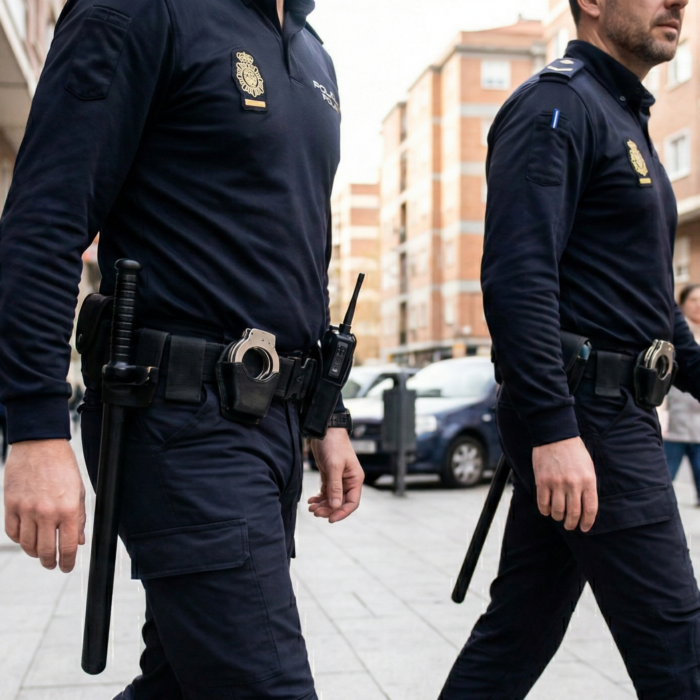
A police officer wearing a ballistic vest, a fully loaded duty belt, and boots can carry between 8 and 12 additional kilograms. If the base uniform does not effectively manage the body’s microclimate—the layer of air between the skin and the fabric—sweat cannot evaporate properly. This leads to an increase in core body temperature, resulting in:
Technical insight: Studies in exercise physiology, such as those published in the Journal of Applied Physiology, indicate that under thermal stress conditions where core body temperature approaches 39°C, physical performance and work capacity may decrease by 15% to 20%.
To effectively combat physical fatigue, technical uniforms must be based on active thermoregulation. At Partenon, we address this need by combining different technical fabrics to achieve optimal performance. By integrating natural and synthetic fibres, we maximise the benefits of each material.
Traditional cotton fabrics have clear limitations in high-stress environments. Modern technical uniforms incorporate advanced synthetic fibres and bi-component blends that:
This process keeps the officer dry, preventing the “wet towel” effect that can dangerously cool the body in winter or cause overheating in summer.
The solution is not a single thick garment, but a modular system. From base thermal shirts for winter to high-ventilation tactical polo shirts for summer, interoperability is key.
If you are planning to update your organisation’s uniforms, consider the following points to maximise investment and performance:
Managing heat stress and physical fatigue is a fundamental pillar in occupational risk prevention for security forces and law enforcement agencies. A well-designed technical uniform allows officers to focus fully on their mission.
At Partenon, we have been innovating for decades to ensure that those who protect society can do so under the best possible conditions. Our experience enables us to deliver solutions that balance durability, performance, and cost efficiency.
Do you need technical advice to define the specifications of your next uniform system?
Contact our team of technical uniform specialists.
ContactBelow, we answer some of the most common doubts of uniformity managers about thermal stress and equipment:
What materials are best for reducing heat stress in police officers?
High-performance polyester blends and polyamides with hydrophilic treatments are among the most effective materials. These fabrics evacuate moisture far more efficiently than cotton. Waterproof yet breathable membranes (such as Gore-Tex® or similar technologies) are also recommended for outer layers..
How does uniform color influence thermal fatigue?
Dark colours (such as navy blue or black) absorb more solar radiation, increasing surface temperature. However, modern fabric technologies include treatments that reflect part of the UV radiation even in dark-coloured textiles, significantly reducing heat absorption
What regulations govern heat protection in work uniforms?
Depending on the specific risk, standards such as EN ISO 11612 (heat and flame protective clothing) or specific standards for ergonomics and thermal comfort may apply. It is vital to consult with the manufacturer to ensure that the garment meets the level of risk of police or emergency activity.
Etiquetas

Entradas recientes